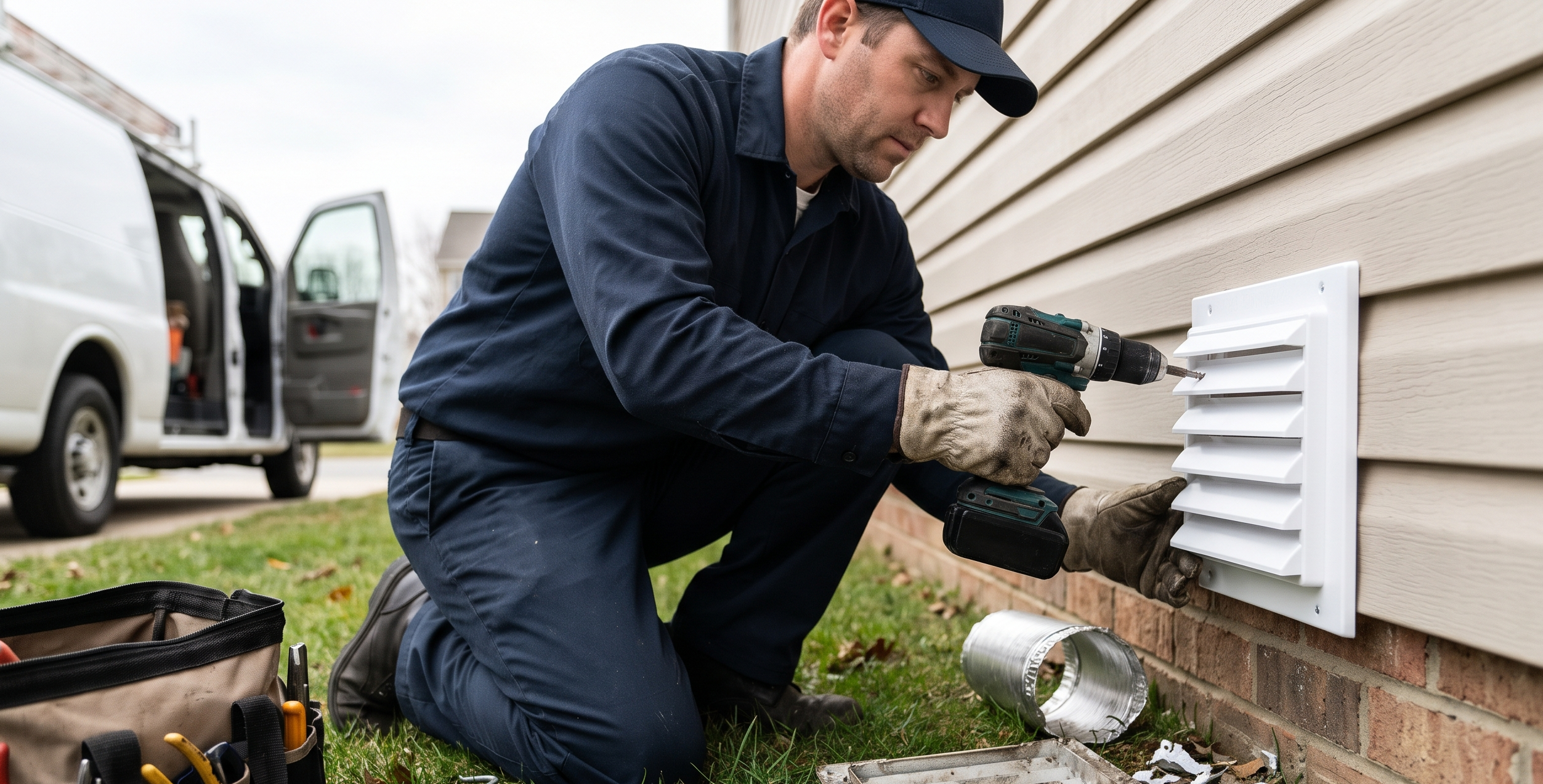
If you’re remodeling your laundry room, you may move the dryer to a new wall or close in the space behind it with new cabinets. Either change usually means you’ll have to replace or reroute the dryer vent, and the new route affects how well the dryer can push air outside.
Too many bends or the wrong kind of duct can make drying take longer and trap lint inside finished walls. Planning dryer vent replacement in Glenview, IL before the walls close lets you keep the run short and easy to clean. Below, you’ll find how to plan the route, which duct materials to use, where the outside hood should go, and what to ask before the installer starts.
Key Highlights
- Every bend counts against a dryer duct’s 35-foot maximum length, so a remodel is a good time to move the dryer closer to an outside wall.
- The connector behind the dryer should be a listed transition duct (UL 2158A), and codes don’t allow PVC pipe for dryer exhaust.
- The outside hood should be at least 10 feet from an air conditioner or heat pump condenser and at least 12 inches above the ground.
- A dryer duct in an unheated space needs insulation, and every run needs support at least every 12 feet.
How Should You Plan the New Vent Route?
Place the dryer where the duct can reach an outside wall by the shortest, straightest path you can manage. Every bend counts against the maximum length, so plan the route as soon as you pick the dryer’s new spot.
The Building America Solution Center, a U.S. Department of Energy resource, limits a smooth metal dryer duct to 35 feet in calculated length, with each bend subtracting from that total. Every bend adds resistance, which is why dryer vent length and routing affect drying time. Check your own dryer’s manual too, since makers set their own length limits.
Plan How the Duct Runs Inside the Walls
Support the duct at least every 12 feet and at every joint, so it doesn’t sag. If the duct passes through an unheated space, insulate it to prevent condensation, and slope it slightly downward so any water can drain.
Which Duct Materials Should a New Dryer Vent Use?
Use rigid or semi-rigid metal duct, 4 inches across, made of galvanized steel or galvanized aluminum. Smaller duct sizes reduce airflow, so keep the run at 4 inches the whole way.
During dryer vent rerouting in Glenview, IL, each part of the new vent has its own rule:
| Part of the Vent | What to Use |
|---|---|
| Main run through the walls or ceiling | Rigid or semi-rigid galvanized metal |
| Short connection behind the dryer | A listed transition duct (UL 2158A), up to 8 feet |
| Any section of the exhaust run | Never PVC pipe, which codes don’t allow for dryer exhaust |
If your current vent uses plastic or flexible foil duct, now is the time to replace it with metal, before the new walls close it in.
Where Should You Place the Dryer Vent Hood on the Outside Wall?
Put the hood on an outside wall at least 3 feet from any opening in the house, such as a window or door. It should also be at least 10 feet from an air conditioner or heat pump condenser.
A few details at the hood keep the vent working well:
- Height and direction. The hood opening should point down and be at least 12 inches above the ground.
- Damper. The hood needs a damper that closes; a louvered damper works better than a single hinged door.
What to Ask Before Your Dryer Vent Installation in Glenview
Settle the plan with your installer before the drywall goes up, since changing a hidden duct later means opening finished walls. Ask these questions about your dryer vent installation in Glenview, IL:
- What’s the calculated length? Ask for the total with every bend counted against the 35-foot limit.
- What duct will you use? Look for rigid or semi-rigid metal for the run, plus a listed transition duct behind the dryer.
- Where will the hood go? Confirm how far it will be from windows and the outdoor condenser.
- How will a technician reach the duct for cleaning? Ask how a technician will clean the run once the walls are finished.
Not every vent problem calls for a full reroute. If the only issue is a crushed transition hose, dryer vent repair in Glenview may be enough. Once the new vent is in, schedule regular dryer vent cleaning in Glenview to keep lint out of the new run.
“Remodeling your laundry room and moving the dryer? SAI Air Duct is family-owned with more than 15 years of experience, and we give free estimates. Contact us or call 224-256-0071 to ask about dryer vent replacement for your home in Glenview.”
FAQs
1. Where should a dryer vent exit the house?
Through an outside wall, at least 3 feet from any window or door and at least 10 feet from an air conditioner or heat pump condenser. The hood opening should point down and be at least 12 inches above the ground.
2. Can you use flexible dryer vent inside a wall?
Not for the hidden part of the run. The flexible transition duct belongs only behind the dryer, up to 8 feet long, and it should be a listed product. The duct inside the wall should be rigid or semi-rigid metal.
3. Can a dryer vent run through an unheated space?
Yes, if that section has insulation to prevent condensation. Slope it slightly downward so any water can drain, and support the duct at least every 12 feet so it doesn’t sag.
4. How do I know if my dryer vent needs replacing?
Plan a replacement if the run uses plastic or unlisted foil duct, or if the hose behind the dryer is crushed. A route longer than the dryer maker’s limits may also need rerouting, since it can make drying take longer.
5. How much does dryer vent replacement cost in Glenview?
It depends on the new route’s length and how the duct runs through your home, so ask for a written quote. SAI Air Duct offers free estimates, so contact us for a price on your Glenview remodel.