


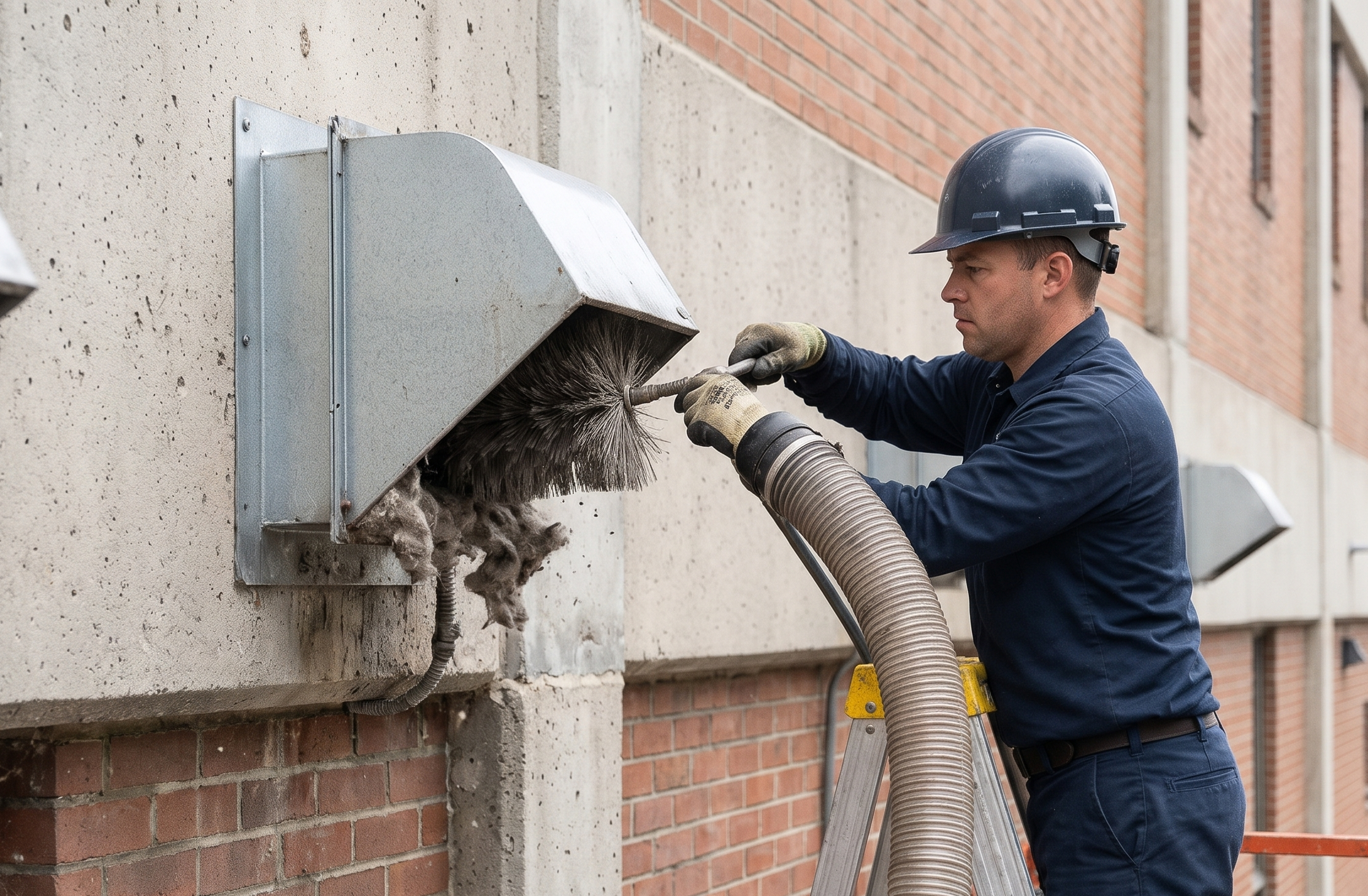
If your business runs several dryers, their vents probably feed into one shared duct hidden above the ceiling or inside a wall. When one dryer starts taking longer than the rest, it’s hard to tell whether the trouble is in its own vent or in the duct they all share.
Lint that builds up in a shared duct can slow more than one dryer, and it’s a fire risk inside your building. Commercial dryer vent cleaning in Glenview, IL should reach each dryer’s own run and the main duct, then confirm the exhaust moves freely with every dryer running. Below, you’ll find how a multi-dryer exhaust system works, what a full cleaning covers and what affects the price.
Key Highlights
- In a multi-dryer setup, each dryer’s exhaust run feeds a larger main duct, and each run needs its own backdraft damper.
- Static pressure in a commercial dryer’s exhaust duct should stay at or below 0.6 inches of water column, measured 2 feet from the dryer while it runs empty.
- The number of dryers and how hard the collector duct is to reach shape most of what a commercial cleaning costs.
- Each dryer needs makeup air, the outside air that replaces what it blows out, through at least 40 square inches of free opening.
How Does a Multi-Dryer Exhaust System Work?
Each dryer has its own short exhaust run that connects to a larger main duct, often called a collector duct, which carries the air outside. Because several dryers share that main duct, lint in one spot can affect more than one machine.
The installation manual from Alliance Laundry Systems, a commercial laundry equipment maker, explains how these parts work together:
- Backdraft dampers. A backdraft damper is a flap that lets exhaust out and closes against backflow. The manual calls for one in each run of a multi-dryer installation.
- The collector duct. This main duct gathers the exhaust from every dryer. When a technician checks its pressure, every connected dryer should be running.
- A clean-out cover. This access panel lets a crew reach inside the duct. The manual calls for one on every system, with a monthly inspection.
- Makeup air. Each dryer needs outside air to replace the air it exhausts, through at least 40 square inches of free opening per unit.
What Does a Full Commercial Dryer Vent Cleaning Cover?
A full cleaning starts at each dryer and ends where the exhaust leaves the building. NADCA (the National Air Duct Cleaners Association) treats this as safety-sensitive work. Crews wear N95 respirators and cut-resistant gloves, and they plan for ladder access and confined spaces.
Clean Each Dryer’s Lint Area and Run
The manual says to remove the lint filter once a year and vacuum the duct beneath it. During a commercial dryer duct cleaning, the crew clears that area first. Then they move on to each dryer’s own run.
Clear the Collector Duct
The crew reaches the collector duct through the clean-out cover. If the duct needs more access, the crew should cut an opening, patch it with metal, and avoid plastic plugs. Ask where any new access openings will go before the crew cuts them.
Check Where the Exhaust Leaves the Building
Lint can also collect where the main duct ends outside. Ask the crew to clear the opening and confirm the exhaust goes straight outdoors.
Measure Static Pressure After the Cleaning
Static pressure is the resistance the exhaust air pushes against inside the duct. The limit is 0.6 inches of water column, measured 2 feet from the dryer while it runs with no load, and every dryer on the collector duct should be running during the check. Ask for the readings in writing, so you can compare them at the next visit.
What Affects the Cost of Commercial Dryer Vent Cleaning in Glenview?
System size and how hard it is to reach drive most of the price. Whether you need laundromat dryer vent cleaning in Glenview or service for an in-house laundry, ask each company about these points so you can compare quotes on the same scope:
- Number of dryers. Each dryer has its own run to clean, so ask for the scope in writing with the dryer count listed.
- Access to the collector duct. A working clean-out cover lets the crew reach the main duct directly. Cutting and patching new openings adds time and material, so ask which the crew plans to do.
- Height and tight spaces. Ducts above a ceiling or ending on the roof require ladders or confined-space work, which the crew must plan for.
- Pressure testing. Ask whether the price includes static pressure readings taken with every dryer running.
- Timing. Dryer vent cleaning for businesses in Glenview goes smoother when the dryers aren’t in use, so ask whether the crew can work outside your busiest hours.
A quote that leaves out the collector duct covers only part of the system, so ask the company to add it. Ask too how often it recommends scheduling commercial dryer vent cleaning for your number of dryers, and train the staff who run them on commercial dryer vent care between visits.
“Running several dryers on one shared duct? SAI Air Duct is a family-owned company with more than 15 years of experience, and we offer free estimates for commercial dryer vent cleaning. Contact us or call 224-256-0071 to plan a cleaning for your business in Glenview.”
FAQs
1. Do commercial dryers need a backdraft damper?
In a multi-dryer installation, yes. The installation manual calls for a backdraft damper on each dryer’s run, a one-way flap in that dryer’s exhaust line. A crew can check that each damper opens and closes freely during the cleaning.
2. Can multiple dryers share one vent?
Yes, in commercial installations set up for it. Each dryer runs to a shared collector duct through its own backdraft damper, and a technician should check the duct’s pressure with every connected dryer running. The dryer maker’s installation manual sets the layout.
3. What is static pressure in a dryer vent?
It’s the resistance the exhaust air pushes against inside the duct. For commercial dryers, one maker sets a limit of 0.6 inches of water column, measured 2 feet from the dryer while it runs with no load.
4. Do commercial dryers need makeup air?
Yes. Each dryer pushes air out of the building, and outside air has to come in to replace it. The opening for that air should have at least 40 square inches of free area per dryer.
5. How much does commercial dryer vent cleaning cost?
It depends on how many dryers share the duct and how the crew reaches it, so get the price in writing before work starts. SAI Air Duct offers free estimates for businesses in Glenview, so contact us to have your system priced.
